The Nuclear Institute
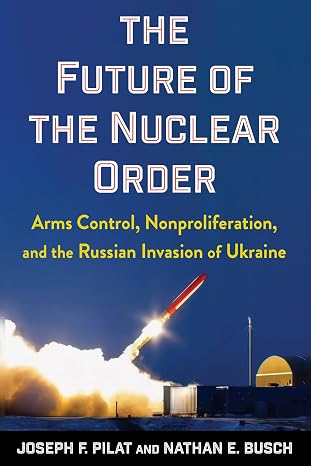
The Future of the Nuclear Order : Arms Control, Nonproliferation, and the Russian Invasion of Ukraine
The Future of the Nuclear Order : Arms Control, Nonproliferation, and the Russian Invasion of Ukraine
Active member price: £25.11
Member discount on printed books
Available to active Nuclear Institute members. Discount applied in the cart or at checkout by adding your exclusive discount code.Vist MyNi to find your discount codes.
Couldn't load pickup availability
The Future of the Nuclear Order : Arms Control, Nonproliferation, and the Russian Invasion of Ukraine
by Joseph F. Pilat (Author) , Nathan E. Busch (Author)
Format:Paperback
Publisher:Columbia University Press
Published:29 Sep 2026
Description
For the past fifty years, international efforts to restrict nuclear weapons have relied on formal treaties, primarily bilateral US-Soviet and US-Russian arms-control and nuclear nonproliferation agreements. These treaties delivered major achievements during the late Cold War and after the collapse of the Soviet Union. In recent years, however, nonproliferation efforts have faced a host of setbacks, including North Korea’s and Iran’s nuclear ambitions.
Now, Russia’s invasion of Ukraine threatens to topple the international nuclear order. The Future of the Nuclear Order explores the difficulties facing nuclear nonproliferation and arms-control efforts today, from the immediate consequences of Russia’s actions to deeper tensions that have been growing in significance. Joseph F.
Pilat and Nathan E. Busch examine the history of international agreements to prevent the spread of nuclear weapons and to scale back the size of nuclear arsenals, placing old and new challenges in context. They analyze the short- and long-term effects of the Russian invasion on the nuclear order, arguing that although the prospects of formal arms-control and nonproliferation regimes have dimmed, a number of informal and nontraditional approaches remain possible, grounded in mutual interest.
Timely and rigorous, this book identifies potential concrete steps that the United States and the international community can take to maintain limited progress on arms control despite significant obstacles.